
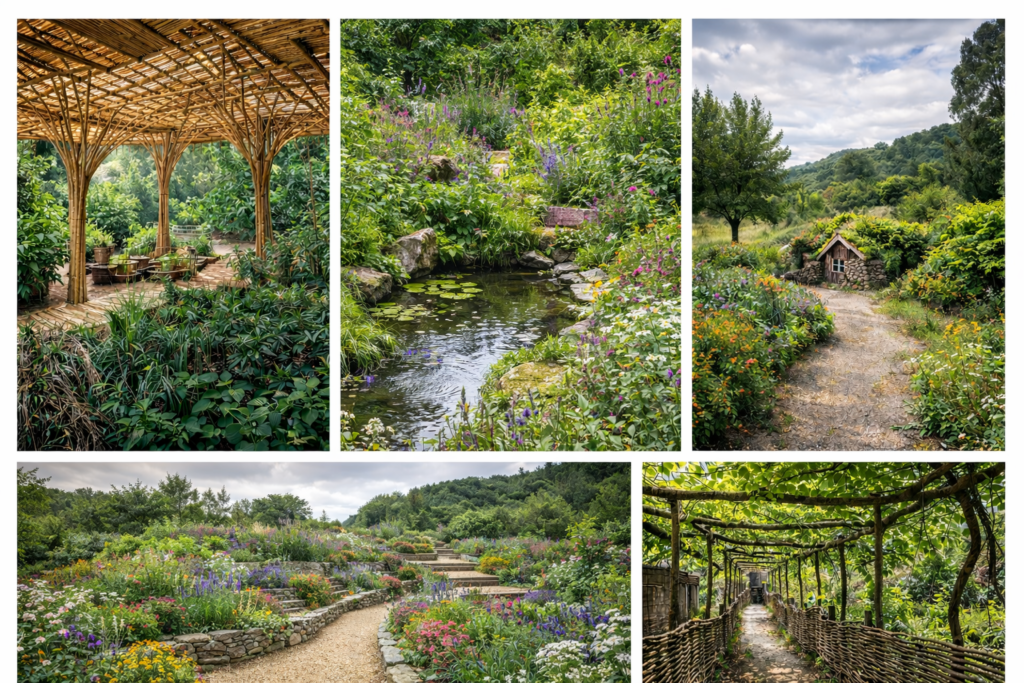
Ne plângem de schimbări climatice şi poluare, de pierderea biodiversității și de presiunea tot mai mari asupra resurselor naturale. Dar ştim rolul important, de microsistem viu, al fiecărei grădini – mai presus de strict rolul ei decorativ. Ştim că fiecare grădină contează. Şi că împreună, toate grădinile fac un lanţ viu, care ne sprijină, dacă le respectăm. Așa cum ne amintește „Împletind iarba sacră” de Robin Wall Kimmerer, restaurarea naturii nu este doar un demers ecologic, ci și unul cultural – o refacere a relației noastre cu pământul, cu natura și cu felul în care alegem să locuim și să îngrijim locurile din jurul nostru. Construcțiile vernaculare, tradiţionale, sunt comori culturale, care oferă soluții simple și dovedite în timp, care îmbină utilul cu respectul față de natură și de locul nostru în lume.
CE SUNT CONSTRUCȚIILE VERNACULARE SUSTENABILE?
Construcțiile vernaculare sunt elemente structurale realizate pe baza cunoștințelor tradiționale locale, folosind materiale naturale disponibile în zonă și tehnici adaptate mediului. Aplicate în grădinile contemporane, sunt soluţii utile şi economice, uşor de realizat, pentru ziduri de piatră, pergole, gardurilor, iazuri, alei permeabile sau sere semi-îngropate. Au avantaje majore, nu doar impact redus asupra mediului. Întreținerea minimă și capacitatea de a genera beneficii ecologice, culturale și estetice pe termen lung le fac un subiect valoros în peisagistica sustenabilă, contemporană.
Aceste principii se înscriu în abordarea europeană a soluțiilor bazate pe natură (Nature-Based Solutions – NBS), definite ca intervenții inspirate și susținute de natură, eficiente din punct de vedere economic și capabile să ofere simultan beneficii de mediu, sociale și economice.
CRITERII PENTRU CONSTRUCȚII PEISAGISTICE SUSTENABILE
Mai mult decât criteriul economic şi de reducere a intervenţiei antropice, peisagistica sustenabilă restabileşte punţile culturale dintre om şi natură – care nu mai e doar o sursă de materiale, destinată distrugerii.
- Contribuție pozitivă pe termen lung asupra mediului
Construcțiile sustenabile sprijină biodiversitatea, stabilizează solul și contribuie la gestionarea naturală a apei, participă la fitoameliorare. Ele reduc efectul de insulă de căldură, captează carbonul și își sporesc valoarea ecologică în timp, prin procese naturale de succesiune. - Absența impactului negativ
Integrarea armonioasă în peisajul natural și cultural este esențială. Materialele locale – piatra, lemnul, lutul, nuielele sau compostul – reduc amprenta de carbon și evită degradarea vizuală, ecologică sau patrimonială. - Întreținere cu impact redus
Construcțiile vernaculare evită utilizarea materialelor poluante și a proceselor energointensive. Ele se bazează pe procese biologice naturale, nu pe intervenții mecanice sau chimice frecvente. - Valoare culturală pe termen lung
Aceste structuri încurajează participarea comunității și transmiterea cunoștințelor tradiționale. Mai mult decât simple obiecte funcționale, ele creează continuitate, identitate și un sentiment de apartenență la loc.
TRADIȚII LOCALE, INSPIRAȚIE GLOBALĂ
În România și Balcani, gardurile împletite din nuiele de salcie sau alun reprezintă o soluție regenerabilă, permeabilă și cu amprentă redusă de carbon, documentată etnografic și ușor adaptabilă grădinilor contemporane.
O soluție ingenioasă pentru prelungirea sezonului de cultivare este reprezentată de serele semi-îngropate, precum vechile „pineapple pits” din Marea Britanie sau walipini-ul tradițional din Bolivia. Acestea folosesc masa termică a solului și energia solară pentru încălzire pasivă.
În Marea Britanie, iazurile etanșate cu bentonită folosesc o metodă tradițională de impermeabilizare cu argilă naturală, susținând biodiversitatea acvatică și calitatea apei, fără membrane sintetice.
Un exemplu remarcabil este utilizarea bambusului în Asia, material regenerabil cu creștere rapidă, folosit pentru pergole, pavilioane, garduri sau mobilier de grădină. Bambusul absoarbe cantități semnificative de CO₂, previne eroziunea solului și reprezintă o alternativă biodegradabilă la oțel sau plastic.
Aleile permeabile, întâlnite istoric în Franța și țările nordice, permit infiltrarea apei și răcirea naturală a solului. Astăzi, ele sunt integrate în sisteme moderne de drenaj sustenabil (SuDS), adaptate mediului urban și rural.
Un exemplu spectaculos de integrare în peisaj sunt casele cu acoperiș de gazon din Islanda, construcții semi-îngropate, datând din secolul al IX-lea. Acestea oferă izolație naturală excelentă și o continuitate vizuală aproape completă cu peisajul înconjurător.
Pergolele de viță-de-vie, răspândite în Balcani și Italia, oferă umbră, productivitate sezonieră și un spațiu social valoros pentru mese și întâlniri în aer liber, devenind un simbol al vieții de familie.
Zidurile de piatră uscată, prezente în Apenini, Irlanda sau Franța, sunt recunoscute ca patrimoniu cultural imaterial UNESCO. Ele creează coridoare pentru biodiversitate, controlează eroziunea și pot dura secole fără mortar.
La scară mai mare, podurile vii – de la ecoductele moderne din Olanda la podurile din rădăcini vii din India – demonstrează cum structurile inspirate din natură pot susține atât mobilitatea, cât și reziliența la inundații.
Irigațiile terasate, practicate din Iran până în Spania, folosesc gravitația pentru a reutiliza eficient apa, reducând eroziunea și evaporarea, și oferind un model relevant pentru grădinile amplasate pe pante.
CONCLUZIE
Construcțiile vernaculare nu țin doar de trecut, ci pot juca un rol important în viitorul grădinilor sustenabile. Sunt soluții simple, solide și bine ancorate în mediul în care apar, care ne arată că tradiția și inovația pot merge firesc împreună. Reinterpretate cu grijă, ele pot transforma grădinile în spații vii, productive și reziliente, pline de sens și legătură cu locul şi rostul nostru.
Aștept cu drag opinii, idei și întrebări pe e-mail.
© 2026 Ioana Petrache http://horticulturaurbana.ro
Aştept opinii şi întrebări pe adresa e-mail.
Bibliografie:
Oliver, P. (2006). Built to meet needs: cultural issues in vernacular architecture. Germany. Architectural. (Part I, Defining the field, p. 28-44.)
Jones, M., & Stenseke, M. (2011). The European Landscape Convention, p. 229 Springer. DOI: 10.1007/978-90-481-9932-7
Schiller, L. (2016). The Year-Round Solar Greenhouse: How to Design and Build a Net-Zero Energy Greenhouse. New Society Publishers.
R W Kimmerer (2023) Împletind iarba sacră: înţelepciunea indigenă, cunoaşterea ştiinţifică şi învăţăturile plantelor, trad., Bucureşti Herald
Manenti, R. (2014). Dry stone walls favour biodiversity. DOI:10.1007/s10531-014-0691-9
Hollingsworth, L. (2020). Forb assemblages of dry stone walls. DOI:10.33928/bib.2020.02.352
Lausen-Higgins, J. (2008). Pineapple growing: Its historical development. DOI:https://doi.org/10.24823/Sibbaldia.2008.34
European Commission(2025) Nature-based solutions – European Commission. Retrieved [date you accessed], from https://research-and-innovation.ec.europa.eu/research-area/environment/nature-based-solutions_en ; https://rea.ec.europa.eu/funding-and-grants/horizon-europe-cluster-6-food-bioeconomy-natural-resources-agriculture-and-environment/nature-based-solutions_en
European Environment Agency. (2021). Nature-based solutions in Europe: Policy, knowledge and practice for climate change adaptation and disaster risk reduction (EEA Report No. 1/2021). Publications Office of the European Union. https://www.eea.europa.eu/publications/nature-based-solutions-in-europe• UK Environment Agency (2014) ; https://www.gov.uk/government/publications/using-bentonite-enriched-soils-in-landfill-engineering-lfe10#:~:text=This%20document%20provided%20guidance%20on%20using%20bentonite,From:%20Environment%20Agency%20Published%2024%20June%202014.
Bamboo and its Role in Carbon Sequestration. (2023, October 2). ResearchGate. https://www.researchgate.net/publication/374381051_Bamboo_and_its_Role_in_Carbon_Sequestration
Lem, C. (2020, October 22). Bamboo architecture: Bali’s Green School inspires a global renaissance. The Conversation. https://theconversation.com/bamboo-architecture-balis-green-school-inspires-a-global-renaissance-121248
https://archello.com/project/yoga-pavilion-at-four-seasons: https://www.cktravels.com/singapore-gardens-by-the-bay/
Stratec 2023 https://www.stratec-geo.com/the-benefits-of-bentonite-liners-basins/
FAO 2024 https://www.fao.org/fishery/static/FAO_Training/FAO_Training/General/x6709e/x6709e03.htm
Solco 2025 https://solco.co.uk/product/solco-bentonite-pond-liner/
CEREMA 2023. https://www.cerema.fr/fr/actualites/desimpermeabilisation-renaturation-sols-serie-fiches-du
SuDs 2025 https://www.susdrain.org/
Plante&Cite 2021 https://e-communautes.cnfpt.fr/sites/default/files/documents_refs/revetements_permeables_plante_et_cite_2021.pdf
Sustainabiliy for all 2025. https://www.treehugger.com/icelandic-turf-houses-old-school-green-viking-twist-4859199
UNESCO 2024 https://ich.unesco.org/en/RL/art-of-dry-stone-construction-knowledge-and-techniques-02106 (stone walls in Europe)
Muzeul Maramuresului 2025 http:// https://muzeulmaramuresului.ro/ (n.d.)
AWRI (2018). https://www.awri.com.au/wp-content/uploads/2018/07/Trentino.pdf
Schaffer, M. (2021, 3 août). The truth about Walipini and geodesic dome greenhouses Ceres Greenhouse Solutions. https://ceresgs.com/the-walipini-low-down/
Khan, G. (2018, March 12). Surreal photos of India’s living root bridges. National Geographic. https://www.nationalgeographic.com/travel/article/living-root-bridges-clean-village-mwalynnong-india
Foto:AIgenerated
